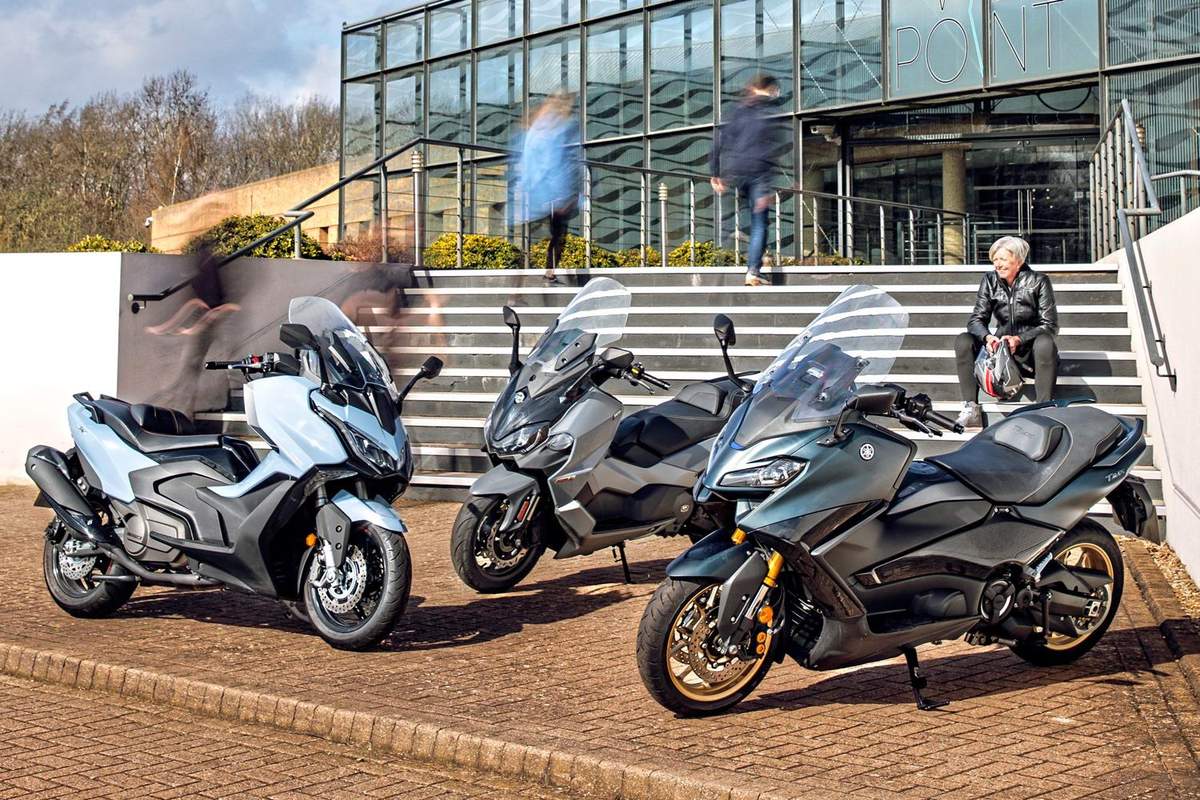
1. Top Maxi Scooter Models: Specs and Pricing Compared
The maxi scooter segment has matured into a legitimate alternative to compact cars and entry-level motorcycles. Four models dominate the US market in 2026, each offering distinct advantages for urban commuters.
Yamaha TMAX (Tech MAX) -- The benchmark. Powered by a 562cc parallel-twin engine producing 47 hp, the TMAX features a lightweight aluminum frame, upside-down forks, and radial-mount brakes. It weighs 478 lbs wet and carries an MSRP of $12,499. The TMAX is the sportiest of the bunch, with a riding position that encourages aggressive cornering while still offering a 15.5-inch seat height that accommodates shorter riders. Fuel economy averages 52 mpg in mixed riding.
BMW C 650 GT -- The luxury tourer. BMW's 647cc parallel-twin engine delivers 60 hp, making it the most powerful in this group. It weighs 549 lbs wet and starts at $13,295. The C 650 GT comes standard with heated grips, a power-adjustable windshield, and a 6.5-inch TFT display with BMW Motorrad connectivity. Its underseat storage fits two full-face helmets, and the seat height is a low 30.9 inches. Fuel economy is 48 mpg.
Suzuki Burgman 650 Executive -- The grand tourer. Suzuki's 638cc parallel-twin engine produces 55 hp and features a unique push-button transmission that mimics a CVT but offers manual mode with paddle shifters. The Burgman 650 weighs 570 lbs wet and costs $11,999. Its 15.5-gallon underseat storage is the largest in class, easily swallowing two full-face helmets plus a laptop bag. The seat height is 29.5 inches, the lowest in this group. Fuel economy reaches 55 mpg.
Kymco AK 550 Premium -- The value king. Kymco's 550cc parallel-twin engine makes 51 hp, weighs 498 lbs wet, and sells for $9,999. The AK 550 offers a 15-inch front wheel, Brembo brakes, and a 6.5-inch LCD dash with smartphone connectivity. Its underseat storage fits two full-face helmets, and the seat height is 30.7 inches. Fuel economy is 53 mpg. For the price, the AK 550 delivers 90% of the TMAX experience at 80% of the cost.
Key Stat: Maxi scooters with 500cc+ engines now account for 22% of all scooter sales in the US, up from 8% in 2020, according to the Motorcycle Industry Council.
2. Practical Advantages: Storage, Seat Height, and Weather Protection
Maxi scooters solve the three biggest pain points of motorcycle commuting: carrying cargo, flat-footing at stops, and staying dry in rain. These practical advantages are why many riders trade their sportbikes for maxi scooters.
Built-in storage for two full-face helmets. Every maxi scooter in this class offers underseat storage that swallows two full-face helmets with room to spare. The Suzuki Burgman 650 leads with 15.5 gallons of storage volume, enough for two helmets, a jacket, and a backpack. The Yamaha TMAX offers 12.4 gallons, while the BMW C 650 GT provides 13.2 gallons. Compare that to a typical sportbike with zero storage or a cruiser with a small saddlebag -- maxi scooters eliminate the need for a top case or tail bag for daily errands.
Low seat height for confidence. The Suzuki Burgman 650 has a 29.5-inch seat height, the lowest in the class. The Yamaha TMAX sits at 31.5 inches, still manageable for most riders. These low seats allow riders to flat-foot both feet at stops, a major confidence booster for new riders or those with shorter inseams. By contrast, adventure bikes often have 33- to 35-inch seat heights that require tiptoeing.
Weather protection from the factory. Maxi scooters come with large front fairings, tall windshields, and floorboards that deflect rain and wind. The BMW C 650 GT's power-adjustable windshield can be raised to cover the rider's entire torso at highway speeds. The Yamaha TMAX offers a fixed windshield that still provides excellent protection. Combined with heated grips (standard on BMW, optional on others), maxi scooters make year-round commuting feasible in most climates.
Automatic CVT transmission. No clutch lever, no gear shifting. Twist and go. This is the single biggest advantage for urban commuting. In stop-and-go traffic, a manual transmission becomes a chore. The CVT eliminates left-hand fatigue and allows the rider to focus entirely on traffic and road conditions. The Suzuki Burgman 650 adds a manual mode with paddle shifters for riders who want occasional control, but the CVT is always there as a fallback.
3. Highway Capability: Cruising at 75-80 mph with Passing Power
The biggest misconception about maxi scooters is that they're underpowered for US highways. That was true of 250cc and 400cc scooters, but 500cc+ maxi scooters are a different animal entirely. These machines are designed for sustained high-speed cruising.
Cruising speed. All four models in this class cruise comfortably at 75-80 mph indicated, which translates to 70-75 mph real-world GPS speed. The Yamaha TMAX and BMW C 650 GT are particularly stable at speed thanks to their aluminum frames and long wheelbases. The Suzuki Burgman 650 feels planted at 80 mph, with its 15.5-gallon storage adding stability. The Kymco AK 550 is slightly buzzy at 80 mph but still comfortable for 30-minute highway stints.
Passing power. The BMW C 650 GT's 60 hp provides the strongest passing punch, accelerating from 60 to 80 mph in about 4.5 seconds. The Yamaha TMAX and Suzuki Burgman 650 are close behind, with 55-60 mph passing times of 5-6 seconds. The Kymco AK 550 takes about 6.5 seconds. For context, a Honda Civic LX takes about 7 seconds for the same pass. Maxi scooters have enough power to merge safely onto highways and overtake semi-trucks without drama.
Braking and stability. All four models come with dual front disc brakes and ABS as standard. The Yamaha TMAX uses radial-mount calipers that provide sportbike-level stopping power. The BMW C 650 GT features BMW's Integral ABS, which links front and rear brakes for balanced stopping. At highway speeds, these brakes inspire confidence. The long wheelbases (62-64 inches) and low centers of gravity make maxi scooters resistant to crosswinds and buffeting from passing trucks.
Real-world highway range. With 4.0- to 4.5-gallon fuel tanks and 50-55 mpg highway, maxi scooters offer 200-250 miles of range per tank. That's enough for a full week of commuting without refueling. The Suzuki Burgman 650's 4.5-gallon tank provides the longest range at 247 miles.
4. Cost of Ownership: Fuel Economy, Insurance, and Maintenance
Maxi scooters are significantly cheaper to own than compact cars and even many motorcycles. Here's the breakdown of real-world costs over three years of ownership.
Fuel economy. Maxi scooters achieve 50-65 mpg in real-world riding. The Suzuki Burgman 650 averages 55 mpg, the Yamaha TMAX 52 mpg, the BMW C 650 GT 48 mpg, and the Kymco AK 550 53 mpg. Compare that to a Toyota Corolla at 32 mpg or a Honda Civic at 34 mpg. At $3.50 per gallon and 12,000 miles per year, a maxi scooter costs $650-875 annually in fuel, versus $1,235 for a Corolla. That's a savings of $360-585 per year.
Insurance rates. Maxi scooters are classified as scooters by most insurers, which means lower rates than motorcycles. Expect to pay $300-600 per year for full coverage on a maxi scooter, compared to $800-1,200 for a sportbike or $1,000-1,500 for a compact car. The Kymco AK 550 is the cheapest to insure due to its lower MSRP and replacement cost.
Tire life. Maxi scooter tires last 8,000-12,000 miles, depending on riding style and tire compound. A set of Michelin City Grip or Pirelli Diablo Scooter tires costs $250-350 installed. That's $0.03-0.04 per mile. By comparison, car tires last 40,000-60,000 miles but cost $600-800 per set, or $0.01-0.02 per mile. Tire costs are slightly higher per mile for scooters, but still negligible in the overall budget.
Maintenance intervals. Maxi scooters require valve clearance checks every 12,000 miles, belt replacement every 15,000-20,000 miles, and oil changes every 3,000-4,000 miles. Annual maintenance costs average $300-500 for a maxi scooter, versus $500-800 for a compact car. The CVT belt replacement is the biggest expense at $200-400 every two to three years, but that's still less than a car's timing belt or transmission service.
Total three-year cost of ownership. Assuming 36,000 miles, a maxi scooter costs approximately $6,500-8,500 in fuel, insurance, maintenance, and depreciation. A Honda Civic costs $12,000-15,000 over the same period. The maxi scooter saves $5,500-6,500 over three years, or about $1,800-2,200 per year.
5. Who Should Buy a Maxi Scooter: Urban Commuters, New Riders, and Manual-Shift Avoiders
Maxi scooters aren't for everyone, but they're ideal for three specific rider profiles. If you fit any of these, a 500cc+ maxi scooter might be your perfect daily ride.
Urban commuters with 20-50 mile round trips. If you commute 10-25 miles each way on city streets and highways, a maxi scooter offers the best balance of speed, storage, and fuel economy. You'll save 15-30 minutes per day by lane-splitting (where legal) and using HOV lanes. The automatic transmission eliminates the clutch fatigue of stop-and-go traffic. The built-in storage means you never need a backpack or top case for your laptop and lunch.
Riders with limited motorcycle experience. Maxi scooters are the perfect stepping stone to motorcycling. The low seat height, automatic transmission, and stable handling make them approachable for new riders. You can focus on traffic awareness and braking without worrying about clutch control or gear selection. After a year on a maxi scooter, many riders feel confident enough to move to a manual motorcycle.
Riders who want motorcycle utility without manual shifting. Some experienced riders simply prefer the convenience of twist-and-go. Maybe you have a left-hand injury, or you're tired of shifting in traffic. Maxi scooters offer the same highway capability as a 500cc motorcycle but with the ease of a scooter. The Yamaha TMAX, in particular, appeals to sportbike riders who want something more practical for daily use.
Riders with shorter inseams. The 29.5- to 31.5-inch seat heights of maxi scooters make them accessible to riders with 28- to 30-inch inseams. Many adventure bikes and sportbikes have seat heights of 33 inches or more, which can be intimidating. Maxi scooters allow shorter riders to flat-foot at stops, building confidence and control.
Budget-conscious commuters. If you're spending $300-500 per month on car payments, insurance, and fuel, a maxi scooter can cut that to $150-250 per month. The Kymco AK 550 at $9,999 is the most affordable entry point, while the Suzuki Burgman 650 at $11,999 offers the best storage and fuel economy. Even the premium BMW C 650 GT at $13,295 is cheaper than a new compact car.